
Female Fertility
For women, the most fertile period is in your mid-twenties and fertility starts to decrease after the age of 35. This is because as women get older our follicle (egg) count declines. The total number of follicles remaining at any given time is known as the ovarian reserve. It gradually declines at a steady rate up until the age of about 35, or when the ovarian reserve has reduced to around 25,000 follicles.
The rate of decline picks up speed after the age of 35 until menopause when only about 1,000 follicles remain.
Getting older is inevitable and we cannot stop the follicle count from declining therefore our focus needs to be on the quality of the remaining follicles.

Supporting Egg Quality
Before ovulation the female egg goes through an important maturation process that begins 3-5 months before ovulation. A good way to consider this phase is "Trimester Zero".
During this time the egg matures within a structured environment called a follicle. The follicle will nurture the egg until it is ready to be released at ovulation into the fallopian tube.
The egg maturation process is energy intensive and the egg follicle needs to be supported.

Egg Development
As you can see from the diagram below, it takes approximately 90 - 120 days for the egg to develop from a tiny follicle to a mature egg ready for ovulation. The ovaries will contain follicles at every stage of development at any given time.
The egg maturation process is energy intensive and the egg follicle needs to be supported. A number of follicles will start the process and through the process of natural selection the best quality egg will be selected at ovulation and be released into the fallopian tube. The egg follicle beginning its journey today will be ready for ovulation in 3-5 months time.
Your diet and lifestyle between now and then can have an impact of its quality.
Ovulation usually happens once during each menstrual cycle.
Because every cycle is different, ovulation does not always happen at the same point each month. Tracking your cycle can help you better understand your fertile window and recognise when you are most likely to conceive.
Our Ovulation Calculator uses your cycle information to estimate when you may be most fertile, helping you plan with greater confidence.

Nutrients
Nutrients play an important role in the development of the egg, womb and the hormonal system. Each month, the reproductive and hormonal cycle develop an egg cell, prepare the womb and a wide range of other processes have to be performed to create the right fertile balance.
The female egg takes approximately 90 days to mature before ovulation. So it is important to prioritise a balanced healthy diet full of essential nutrients in the months before conception.

About Proceive Women
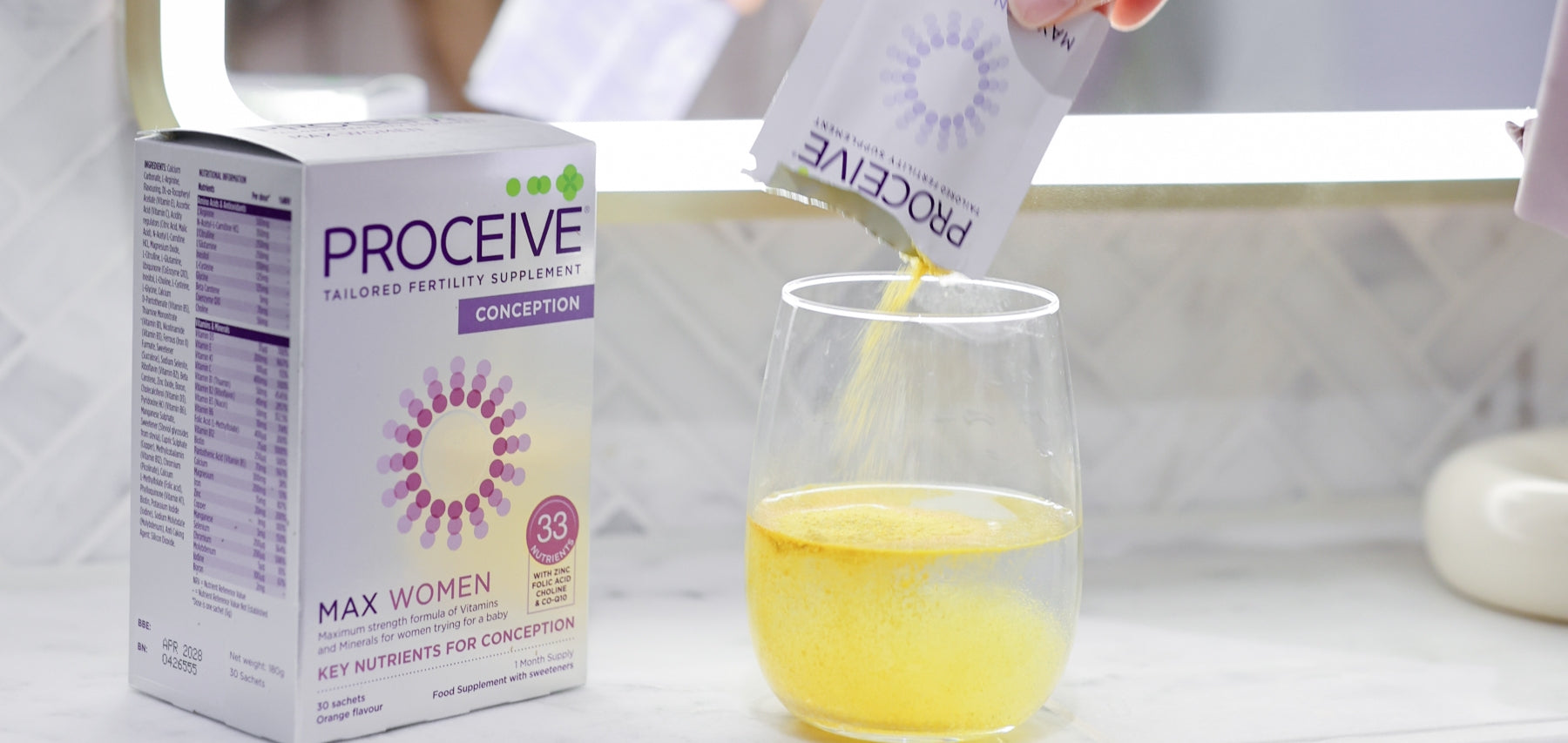
Nutrients play an important role in the development of the egg, womb and the hormonal system. Many of these processes use nutrients. A healthy lifestyle, a balanced diet and taking enough exercise are important when trying for a baby. It can be difficult to get all the nutrients you need from your diet in today’s busy world. This is where Proceive Women may help by providing the extra support needed to support good pre-conception health.


Compare Female Conception Formulas

|

|

|
|
|---|---|---|---|
|
Strength
|
3,237mg
|
1,038mg
|
357mg
|
|
Number of Nutrients
|
33
|
28
|
21
|
|
Format
|
Sachet
|
Capsule
|
Tablet
|
|
Tailored Formula
|
|
|
—
|
|
L-Methylfolate
|
|
|
—
|
|
Free From Fillers, Binders & Artificial Colours
|
|
|
—
|
|
Certified Vegan
|
|
|
—
|
The Difference Between Women's Formulas
We are often asked "What's the difference between Proceive Women and Proceive Max Women?"
To find out more and understand which product is best for you, click below.